


mathematics
Subject Leader: Mr Murday
Mathematics Intent
At Barnfields Primary School, we believe that children deserve an ambitious mathematics curriculum that prepares them for everyday life and future employment. Our mathematics curriculum adopts the mastery approach, enabling the children to acquire a deep, long term, secure and adaptable understanding of the subject. The curriculum focuses on the fundamentals of number, geometry, measurement and statistics.
Our mathematics curriculum will give children the opportunity to become fluent in the fundamentals of mathematics. They are taught to reason mathematically by following a line of enquiry, finding connections and establishing relationships whilst using mathematical language. Children are taught to solve problems by applying their mathematics to a variety of routine and non-routine problems with increasing sophistication, including breaking down problems into a series of simpler steps and persevering in seeking solutions.
Our Mathematics Approach at Barnfields
Mathematics is a core subject of the National Curriculum. All pupils take part in daily, coherent mathematics lessons which cover the programmes of study in a rigorous and progressive manner, as set out in the National Curriculum and EYFS Statutory Framework. At Barnfields, we believe that every child can achieve in mathematics and that all pupils should develop the knowledge, skills and confidence required to succeed as mathematicians, both now and in the future.
Our mathematics curriculum is ambitious and carefully designed to ensure that pupils develop deep conceptual understanding, procedural fluency, reasoning skills and the ability to solve increasingly sophisticated problems. We recognise that mathematical learning is most effective when children are given opportunities to build secure foundations, make meaningful connections and apply their understanding in a range of contexts.
Teachers therefore plan learning that is carefully sequenced, builds upon prior knowledge and enables pupils to develop confidence whilst maintaining high levels of challenge.
At the planning stage, teachers carefully consider how learning can be made memorable, engaging and accessible for all learners. Lessons are designed to identify potential misconceptions before they arise, provide appropriate scaffolds where necessary and offer opportunities for pupils to deepen their understanding through greater reasoning and application. Assessment is used continuously throughout lessons to inform teaching and ensure that pupils remain on a successful learning journey. Examples of our ambitious mathematics provision include:
- Use of White Rose Mathematics to support progression and curriculum sequencing.
- A scheme-assisted rather than scheme-led approach which enables teachers to exercise professional judgement.
- A consistent Concrete, Pictorial and Abstract (CPA) approach across all year groups
- Daily opportunities for fluency, reasoning and problem-solving
- Deepen the Moment challenges, identified in yellow, to develop greater depth of understanding
- Regular retrieval practice to strengthen long-term memory and retention of key knowledge
- Explicit teaching of mathematical vocabulary
- Effective mathematical discussion and learning conversations
- Adaptive teaching which provides support and challenge whilst maintaining high expectations
- Careful identification and addressing of misconceptions
- Strategic use of manipulatives and mathematical representations
- Bar modelling to support conceptual understanding and problem-solving
- Times Tables Rock Stars and regular multiplication fluency practice
- Precision Teaching and targeted intervention where appropriate
- Pre-teaching through intervention groups and Morning Club (SPARK) provision
- Effective deployment of teaching assistants in line with EEF guidance
- Ongoing staff development, coaching and mathematics subject-specific CPD
Children are taught through a combination of whole-class teaching, guided group work, collaborative learning and independent practice. Pupils are given opportunities to work individually, in pairs, within small groups and as part of whole-class discussion. Mathematical skills are approached in varied and systematic ways to ensure children develop a broad range of strategies and become increasingly flexible and efficient in their mathematical thinking. A range of adaptive teaching strategies are used throughout the school to ensure that the curriculum remains inclusive whilst retaining ambition and challenge for all learners.
Early Years Foundation Stage
Mathematics in the Early Years Foundation Stage is planned in accordance with the EYFS Statutory Framework and provides the foundations upon which future mathematical learning is built. Our curriculum focuses on developing secure understanding within the areas of number and numerical patterns, whilst fostering curiosity, confidence and enjoyment. Children experience mathematics daily through a combination of direct teaching, adult-led activities and carefully planned continuous provision opportunities, both indoors and outdoors. Learning is practical, engaging and rooted in meaningful experiences. Children develop fluency in counting, subitising, recognising patterns, comparing quantities and solving simple addition and subtraction problems. Great emphasis is placed upon the development of mathematical language and vocabulary to enable children to communicate their thinking confidently. In addition, children develop their understanding of shape, space and measure through high-quality practical experiences which encourage exploration, investigation and problem solving. Mathematics is carefully woven throughout all areas of provision to ensure children continually revisit and apply previously taught learning. White Rose Mathematics supports planning and progression, whilst retrieval opportunities help children embed key concepts and build strong foundations for Key Stage One.
Key Stage One
The principal focus of mathematics teaching in Key Stage One is to develop confidence and fluency with whole numbers, counting, place value and the four operations. Children work with numerals, mathematical language and practical resources to develop secure conceptual understanding and increasingly efficient methods of calculation. Pupils are taught to recognise, describe, compare and sort shapes, whilst also developing their understanding of measures including length, mass, capacity, volume, time and money. Mathematical vocabulary is explicitly taught and regularly revisited so that pupils develop confidence in communicating and explaining their thinking. Reasoning and problem solving are embedded throughout learning, enabling children to apply their understanding in a range of contexts. By the end of Year 2, the majority of pupils will achieve the expected standard within the curriculum, with some pupils working towards expectations and others demonstrating greater depth through increasingly sophisticated reasoning and application.
Lower Key Stage Two
The principal focus of mathematics teaching in Lower Key Stage Two is to ensure that pupils become increasingly fluent in the four operations, place value and number facts whilst developing efficient written and mental calculation strategies. Children apply their understanding to a wider range of concepts including fractions, decimals, measurement and geometry. They are encouraged to identify patterns, make connections, explain their reasoning and justify their conclusions. Teaching promotes both accuracy and efficiency whilst continually strengthening mathematical understanding. A significant focus is placed upon multiplication fluency, with pupils participating in regular times tables practice through classroom activities, retrieval tasks and Times Tables Rock Stars. By the end of Year 4, children are expected to have secure recall of multiplication and division facts up to 12 × 12, preparing them successfully for the Multiplication Tables Check and laying the foundations for future learning in Upper Key Stage Two.
Upper Key Stage Two
The principal focus of mathematics teaching in Upper Key Stage Two is to extend pupils' understanding of the number system and enable them to apply their knowledge confidently across a broad and increasingly complex range of mathematical concepts. Pupils develop deeper understanding of fractions, decimals, percentages, ratio, proportion and algebra whilst continuing to strengthen arithmetic fluency. They are encouraged to solve increasingly sophisticated multi-step problems, select efficient methods and explain their mathematical thinking with precision. Teaching supports pupils in making connections between different areas of mathematics and applying their learning in unfamiliar contexts. Geometry and measures build upon previously acquired knowledge and require increasingly advanced reasoning and analytical thinking. By the end of Year 6, pupils are expected to be fluent in formal written methods for all four operations, as outlined within the Barnfields Calculation Policy, and demonstrate confidence when working with fractions, decimals and percentages. This ensures they are well prepared for the mathematical demands of Key Stage Three.
Concrete, Pictorial and Abstract (CPA)
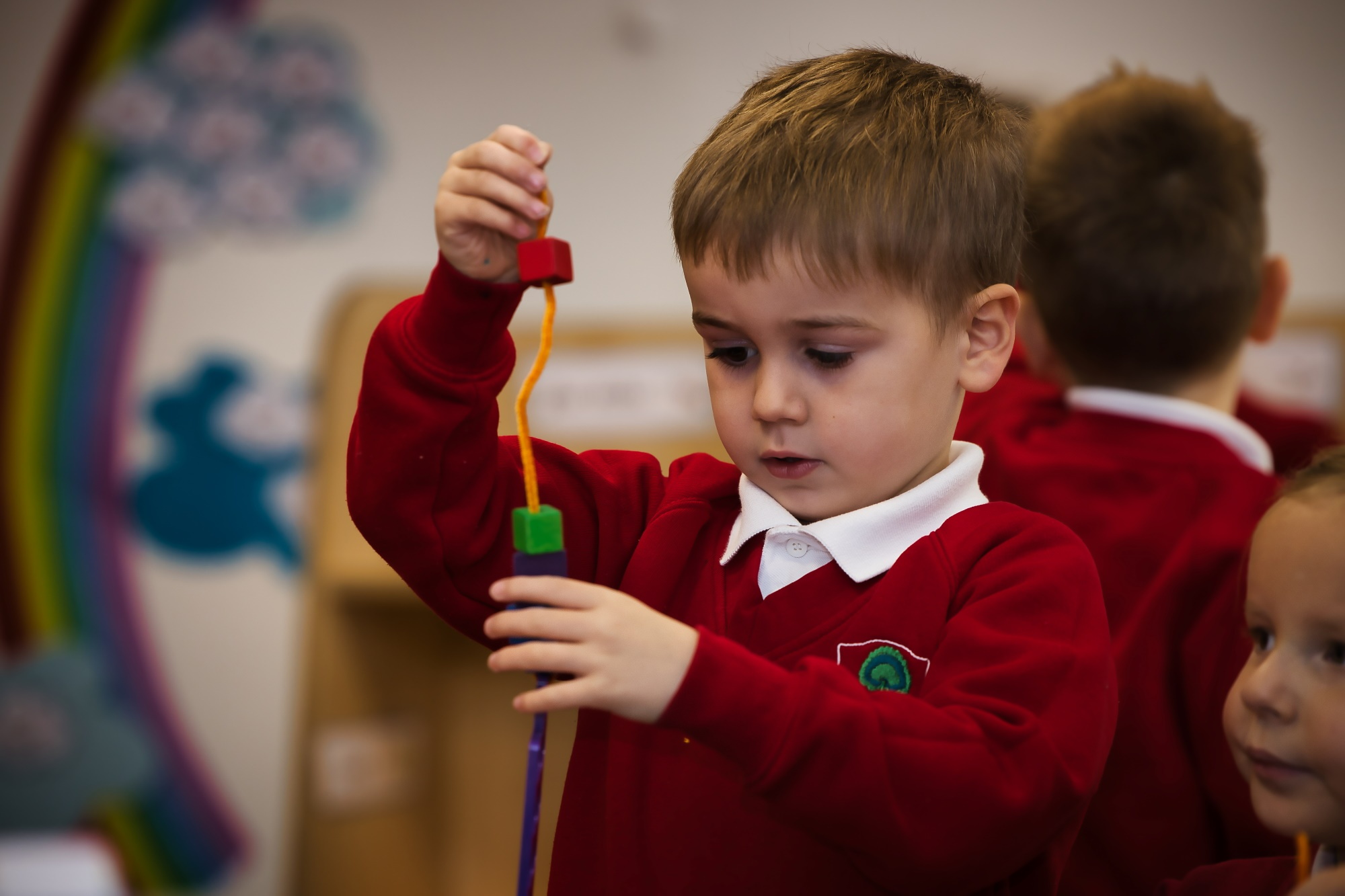
The Concrete, Pictorial and Abstract approach is embedded throughout the Barnfields mathematics curriculum. We recognise that pupils develop the deepest understanding when they are able to visualise mathematical concepts, recognise patterns and understand the relationships between ideas. Children are first introduced to concepts through practical exploration using concrete resources. They then move towards pictorial representations before progressing to abstract mathematical notation. Resources such as Numicon, dienes apparatus, place value counters, bead strings, number lines and tens frames are used purposefully to strengthen understanding and support progression. The CPA approach ensures that learning is accessible, inclusive and rooted in secure conceptual understanding. It supports pupils in developing mathematical confidence and enables them to visualise concepts effectively when working independently.
Reasoning
Reasoning is at the heart of mathematics teaching at Barnfields. We aim to develop pupils who can think systematically, communicate clearly and justify their ideas using precise mathematical language. Pupils are given daily opportunities to explain, prove, convince, compare and evaluate. Teachers use carefully structured questioning and high-quality discussion to help children articulate their thinking and develop increasingly sophisticated mathematical reasoning. Through reasoning, children are encouraged to explore different approaches, make generalisations and develop a deeper understanding of mathematical concepts. Reasoning opportunities are an integral feature of lessons and are regularly evidenced within pupils' work as part of our commitment to developing confident and reflective mathematicians.
Retrieval Practice
Retrieval practice is a key component of mathematics teaching at Barnfields. We recognise that successful learning depends upon knowledge being retained and readily accessible when needed. Teachers therefore plan regular opportunities for pupils to revisit previously taught concepts, methods and mathematical facts. Retrieval tasks are deliberately designed away from the current learning sequence, requiring pupils to draw upon prior understanding and strengthen long-term memory. These activities support fluency, improve retention and provide valuable assessment information that informs future teaching.
Deepen the Moment
A distinctive feature of mathematics at Barnfields is the use of Deepen the Moment challenges. Once pupils have demonstrated fluency and applied their learning through reasoning and problem-solving activities, they are provided with opportunities to deepen their understanding further. Identified in yellow within learning materials, Deepen the Moment challenges require pupils to justify, prove, generalise, investigate patterns and make increasingly sophisticated mathematical connections. These tasks enable pupils to work at greater depth within the year-group curriculum and promote genuine mathematical thinking rather than simple acceleration onto future content.
Bar Modelling
Bar modelling is used consistently throughout the school as a powerful visual representation strategy. It supports pupils in identifying relationships between quantities, understanding mathematical structures and selecting appropriate operations when solving problems. By representing information visually, children develop a deeper understanding of mathematical concepts and become more confident problem solvers. Bar modelling supports fluency, reasoning and conceptual understanding and contributes significantly to the development of mathematical mastery.
___________________________________________________________________________________________________________________________
Times Tables
In the new Primary National Curriculum, times tables up to 12 x 12 are something which children are required to know and understand by Year 4. To help with this, we use Times Table Rockstars so children and teachers know where pupils are up to in their learning of times tables.
When it comes to times tables, speed and accuracy are important – the more facts your child remembers, the easier it is for them to do harder calculations.
To be a Times Table Rock Star you need to answer any multiplication fact up to 12×12 in less than 3 seconds!
Year Group Expectations
Year 2: 2, 5 and 10
Year 3: 2, 3, 4, 5, 8 and 10
Year 4: 2, 3, 4, 5, 6, 7, 8, 9, 11, 12
Year 5: all facts to 12 x 12
Year 6: all facts to 12 x 12