





Curriculum STRUCTURE

Curriculum Structure at Barnfields
At Barnfields, the broad and balanced curriculum is coherently and progressively planned and sequenced towards cumulatively sufficient knowledge and skills for future learning and employment. Curriculum Outlines have been produced for each year group, providing an overview of the content that is being taught in each topic, in each subject, from Yr1-6. These ensure full compliance with the KS1 and KS2 National Curriculum.
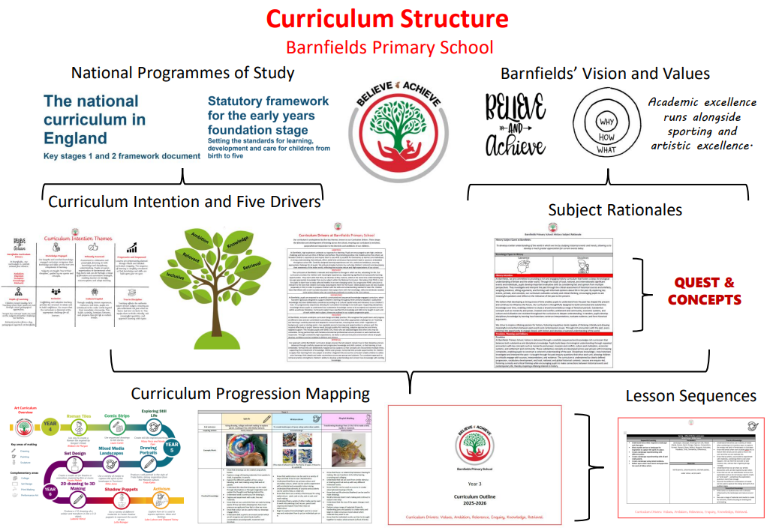
Staff at Barnfields are passionate about ensuring that the planning and teaching of each subject remains ‘true to discipline’. Knowledge and skills (knowledge-engaged) are two core components of the design, enabling learners to build upon what they have learnt. We teach through a topic-based approach, but, where links cannot be made or are tenuous, subjects are taught on a stand-alone basis. Subjects such as Computing, MFL (French), PE, RSHE, RE, and Music are all scheme-assisted subjects. These carefully selected schemes, such as Jigsaw PSHE, ensure that pupils develop the specific skills and knowledge required in each subject through a structured and progressive approach.
In English, leaders foster a love of reading and language by immersing learners in high-quality texts, providing them with the confidence to explore their imagination through our literature-led curriculum. Writing is taught through a carefully sequenced series of lessons that incorporate a range of effective teaching strategies to develop language, structure, and creativity. Opportunities are provided for learners to enrich and extend their writing independently, enabling them to apply key skills in meaningful contexts. At the end of each unit, pupils plan, write, and edit a piece of independent work, with the editing process encouraging reflection and supporting them in improving the quality of their writing.
In Mathematics, we use the White Rose Scheme of Learning to future guide and support teaching practice and pedagogy from Reception to Year 6, which carefully sequences concepts and procedures to build mathematical knowledge and skills systematically over time. There is a distinct focus on number work. Children who have an excellent grasp of number make better mathematicians. Spending longer on mastering key topics will build a child’s confidence and help secure understanding. The scheme breaks the curriculum down into small, manageable steps that all children work on in a daily lesson together. Those that need a bit more support are provided with extra scaffolding through the use of modelling, resources and adult support. Those that require more challenge are given complex tasks and deeper problems to build a more profound understanding. The scheme interleaves prior content with new concepts. This helps children make links between topics and understand them more deeply.
|
Across the foundation subjects, Road Maps outline the units taught within each subject, demonstrating a balance of each aspect studied (e.g. mechanisms, food and nutrition, textiles in Design Technology). Knowledge-engaged progression grids (unique to Barnfields) are in place to support the planning process. These documents outline the powerful knowledge that must be taught in each unit, ensuring that lessons are coherently built across the school and vertical links made to support remembering. In Science, History, Geography, Design Technology and Art, this is further supplemented through the medium-term planning documents, which outline: key vocabulary, scientists/significant individuals/artists studied, lesson sequences, prior and future knowledge. These documents work in tandem with each other, enabling the staff to plan progressive and well-considered lesson that thoughtfully incorporate retrieval practice. Each subject taught at Barnfields Primary School has a Subject Rationale which explains the purpose, intent, and guiding principles behind each subject within our curriculum. They outline the subject’s quest and concepts, the subject intent and design, how it contributes to pupils’ overall development, and how it connects to the school’s wider vision and values. The rationale sets out what the subject aims to achieve, the knowledge and skills pupils will gain, and how learning is structured to ensure progression over time. It serves as a foundation for curriculum design, teaching, and assessment, ensuring that all pupils receive a coherent, meaningful, and ambitious learning experience. Each rationale is underpinned by the most recent educational research, such as the Ofsted Research Reviews. |